
Textes de rupture
Tribune juive publie ici des textes intellectuels, français ou étrangers, dont la radicalité analytique nourrit le débat contemporain, sans impliquer nécessairement une adhésion intégrale de la rédaction à chacune de leurs conclusions.
Note de la rédaction
Le texte qui suit n’est pas une traduction littérale.
L’essai original de l’intellectuel égyptien Hussein Aboubakr Mansour est long, dense, parfois volontairement labyrinthique. Nous avons fait un autre choix : celui d’en proposer une adaptation française, éditoriale et resserrée, fidèle à sa thèse centrale mais retravaillée pour le lecteur francophone.
Pourquoi ?
Parce qu’un texte important peut parfois se perdre dans sa propre profusion. Et parce qu’il nous a semblé que l’intuition fondamentale de cet essai méritait mieux qu’une simple transposition universitaire.
Cette intuition est la suivante : la « question palestinienne » n’est plus seulement un conflit territorial ou diplomatique. Elle est devenue, dans une grande partie du monde, une structure symbolique autonome ; un langage global dans lequel se projettent culpabilités occidentales, humiliations arabes, imaginaires révolutionnaires, théologies inversées, stratégies régionales et haines anciennes.
Que l’on adhère ou non à toutes les conclusions de l’auteur, il nous a paru impossible d’ignorer la puissance de certaines de ses analyses.
Ce texte n’est donc ni un manifeste, ni un catéchisme, ni un texte « de ligne ». C’est une proposition intellectuelle. Une lecture possible du monde contemporain. Et peut-être aussi un avertissement.
Il existe des conflits. Et il existe des mots qui finissent par devenir davantage que des conflits.
Selon Hussein Aboubakr Mansour, « Palestine » n’est plus seulement un territoire, une cause ou une guerre. Le mot est devenu un système.
Un système mondial de production symbolique où viennent se rencontrer culpabilité occidentale, humiliation arabe, militantisme révolutionnaire, carrière universitaire, théologie inversée, haine du Juif, besoin de rédemption et stratégies géopolitiques.
Autour de ce mot gravite désormais une économie entière : morale, idéologique, médiatique, diplomatique.
Et cette économie possède une singularité rare : chacun y trouve son compte.
Le militant anticolonial y trouve son mythe fondateur.
L’islamiste, sa guerre sacrée.
L’Occidental post-chrétien, une manière de rejouer — parfois jusqu’à l’effacement — sa propre culpabilité historique envers les Juifs.
Les régimes arabes, un dérivatif commode à leurs propres échecs.
Les ONG, un carburant moral.
Les universités, une langue de vertu.
Les puissances régionales, une monnaie d’influence.
Le plus troublant, dans cette analyse, est qu’elle ne repose pas sur l’idée d’un complot.
Au contraire.
Le système fonctionne précisément parce qu’il n’a pas de centre.
Personne ne le dirige.
Personne ne le contrôle totalement.
Et pourtant chacun contribue à le maintenir vivant.
Mansour décrit ici ce qu’il appelle un système « autopoïétique » : une mécanique qui se nourrit d’elle-même, reproduit ses propres conditions d’existence et transforme chaque crise en nouveau carburant.
Dans cette logique, la souffrance palestinienne devient une monnaie symbolique universellement convertible.
Non pas la souffrance en soi. Mais la souffrance palestinienne au contact de la présence juive et israélienne.
C’est cette combinaison particulière qui produit, selon lui, une charge symbolique sans équivalent dans le monde contemporain.
Car le « symbole Palestine » possède une propriété unique : il peut être réinterprété simultanément par des idéologies pourtant incompatibles entre elles: le marxiste y voit le colonialisme absolu. L’islamiste, une nouvelle croisade. Le nationaliste arabe, l’humiliation originelle du monde arabe. Le progressiste occidental, la lutte des opprimés contre les dominants. Le conservateur américain, la frontière avancée de l’Occident contre la barbarie. Et l’Européen post-Holocauste y cherche parfois, plus obscurément, une manière de déplacer sa propre faute historique.
Tous parlent du même objet. Mais aucun ne parle réellement de la même chose.
Et pourtant le système fonctionne.
C’est là, peut-être, le cœur de cette réflexion : la question palestinienne serait devenue moins un conflit qu’un immense réservoir mondial de sens, de morale, d’identité et de projection. Un lieu où chacun vient déposer quelque chose qui le dépasse.
L’auteur va plus loin encore. Il affirme que ce « mot-symbole » finit par capturer l’esprit politique de sociétés entières. Il prend l’exemple de l’Égypte. Pendant des décennies, explique-t-il, tout y ramène à Israël : la pauvreté, la corruption, l’absence de démocratie, l’échec des institutions, la dépendance économique, les humiliations nationales.
Non que ces mécanismes soient entièrement fictifs. Mais parce qu’à force de tout expliquer par Israël, les sociétés concernées finissent par ne plus pouvoir penser leurs propres impasses autrement.
Le symbole occupe alors tout l’espace mental. Et lorsqu’une société ne peut plus penser ses propres défaillances autrement qu’à travers un ennemi extérieur, elle devient prisonnière d’une boucle sans fin.
Le plus dérangeant, dans ce diagnostic, est qu’il ne s’arrête pas au monde arabe.
Mansour suggère que l’Occident lui-même commence désormais à être capturé par ce même mécanisme symbolique. Comme si « Palestine » était devenue, bien au-delà du Proche-Orient, une matrice émotionnelle globale : un langage de purification morale permettant à chacun d’exprimer sa colère, sa culpabilité, son besoin de camp, son désir d’innocence.
Alors le conflit cesse d’être un conflit: il devient une religion politique. Et dans toute religion politique, l’hérésie finit toujours par remplacer le débat. Le danger, écrit-il en substance, n’est pas seulement la haine. Le danger est l’impossibilité progressive de penser hors du symbole.
Car lorsqu’un mot devient un système, il ne décrit plus le réel: il finit par le produire.
Texte adapté et édité par la rédaction de Tribune juive à partir d’un essai original de Hussein Aboubakr Mansour.
Texte original
A Metacritique of Palestine
On the Political Economy of a Word-Symbol
Hussein Aboubakr Mansour
May 18
Note to reader: What follows is long, it is demanding, and it will be unpleasant for every reader regardless of where they stand. I make no pretense of humility about what this essay attempts: I believe it to be the most comprehensive and honest account of this subject yet produced. The essay builds toward its most vital material in the final sections; the reader who stops before the end will have missed the revelatory part. Do not skip the last third. Everything before it is preparation. Everything after the turn is what the preparation was for.
There is no shortage of writing about Palestine. This small and provincial conflict has generated more commentary, more theory, more denunciation, more advocacy, and more counter-advocacy than any comparable political question of the modern era, and the volume of this commentary has stood in inverse proportion to its analytical value.
The reason for such a lack of value is that what has been written is, with rare exceptions, written from inside the very structure that the writing claims to describe, and the writing therefore serves the structure rather than illuminating it. The liberal who writes about human rights, the leftist who writes about settler colonialism, the realist who writes about regional security, the conservative who writes about the clash of civilizations, the Islamist who writes about Crusaders, the Arab nationalist who writes about Western betrayal, and the post-Christian European who writes about the unbearable irony of Jewish power are not, despite their mutual hostility, engaged in incompatible projects. They are engaged in the same project, which is the conversion of the victimhood, regardless of its details, produced at a particular site into a particular kind of symbolic capital usable within a particular ideological market. They quarrel about the terms of the conversion. They do not quarrel about the conversion itself, because the conversion is what they all live on.
This essay is an attempt to step outside that conversion long enough to describe the system that makes it possible. The attempt is necessarily imperfect, because no one stands fully outside the system, and the writer who claims such a vantage is either lying or mistaken about his own position.
What is possible is the more modest achievement of seeing the Palestine system as a structure rather than as a contest within which one has already chosen a side. This requires the reader to suspend, at least for the duration of the essay, the question of which party is right and to consider instead the question of what kind of arrangement produces the very ground on which the question of rightness gets posed. The reader will recognize, I hope, that this suspension is not a refusal of moral judgment but its precondition. One cannot judge what one has not first understood, and the Palestine word-symbol has been, for at least three generations, a question about which everyone has had opinions, and almost no one has had understanding.
What I will describe below is Palestine, not as a place, nation, idea, or cause, but as one of the world’s largest systems of political and economic extraction. The word system is overworked, and I use it with some reluctance, but no other word in the available vocabulary captures what I mean. I do not mean a conspiracy, because there is actually no one conspiring. I do not mean a structure in the strong Marxist sense, because there is no base from which the rest is derived, and there is no priority or point of origin. I do not mean an institution, because the arrangement crosses every institutional boundary that modern political life recognizes.
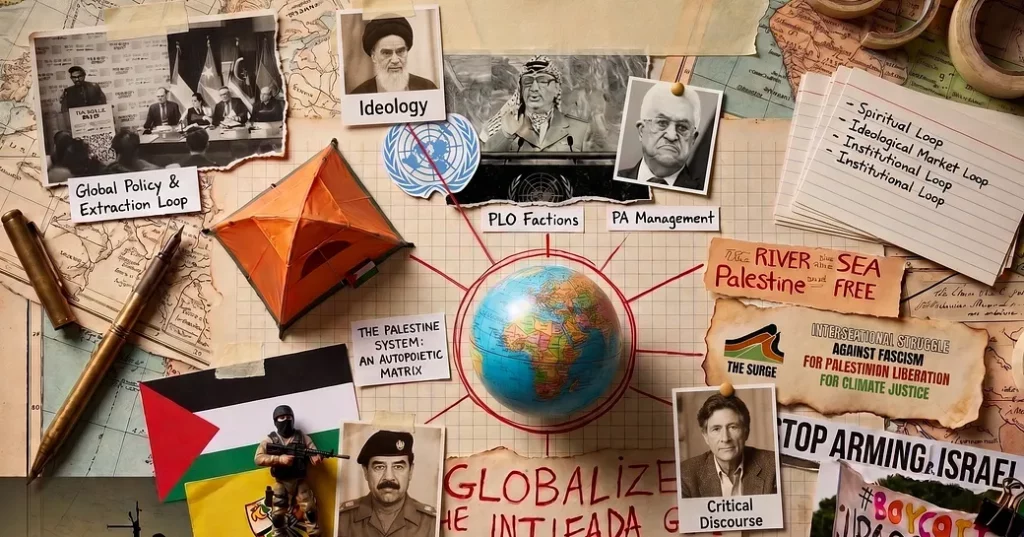
I mean an autopoietic system; decentralized, self-generating, and closed. It is a self-reproducing pattern of extraction that operates simultaneously across multiple independent domains—spiritual, ideological, institutional, geopolitical, economic, and local—each running on its own logic and its own incentive structure, none reducible to the others, and all converging to produce a stable aggregate that no participant designed and no participant can dissolve. In the simplest terms, Palestine is a symbolic-convertibility system: a machine that transforms Palestinian suffering, Jewish presence, Arab humiliation, Western guilt, Islamist eschatology, leftist anti-imperialism, liberal humanitarianism, NGO careerism, regime strategy, and personal self-justification into mutually reinforcing forms of value.
The pattern that makes up the system, and which is condensed in the Palestinian word-symbol, has no center. It has no origin point. It has no master node whose removal would collapse the whole. It has no class of beneficiaries who could be deprived of their benefits to restore justice, and it has no class of victims who could be liberated to end the system, because in this system every participant is simultaneously a victim and a beneficiary, a captive and an extractor, a sufferer and a profiteer. The fusion is precisely the condition of participation.
Fact Check: Yes, photographers have genuinely captured images of starlings flying in the shape of a bird
A murmuration of starlings. No bird leads, and no bird sees the shape. Each responds only to the few nearest it, and the form emerges from the aggregate of countless local decisions that no participant designed and no participant controls. The visual phenomenon indeed has a reality. It moves and coheres, but it exists nowhere except in the pattern produced by the convergent motion of individuals who do not know they are producing it. There is no center. There is no base. There is no bird whose removal would collapse the whole. This is the kind of system the essay describes.
Now, Palestine the system is organized around Palestine the word-symbol. By Palestine word-symbol, I mean neither Palestine as territory nor Palestine as people nor Palestine as political cause, but the charged verbal object through which those realities are converted into a portable structure of meaning. It organizes perception, assigns guilt, distributes moral standing, and converts suffering into symbolic value. This aspect, which we discuss at the end of the essay, is the precondition that makes the extractive system possible.
I should say, before going further, who I am and why I am writing this. I am an Egyptian. I was raised, like every member of my generation in my country, to understand the liberation of Palestine as the central political and moral question of my existence, the lens through which every other question about the world was to be focused, and the framework within which my own dignity as a person and as a member of my civilization was to be measured.
I spent my childhood and adolescence inside the cognitive trap that this essay will describe, and I spent my adulthood, in a process that was neither easy nor complete, climbing out of it. The climb did not end in any promised land. It ended in the ability to see what I had been inside of, which is a small reward for a great labor, and which provides no relief from the recognition that hundreds of millions of people remain inside the trap I have left, and that they cannot be argued out of it because the structure is not an argument, and that I cannot return to it because the return would require an unknowing that no one who has known can perform.
This essay is not a memoir; contemporary memoirs are a moral dead-end of solipsism and narcissism, an endless self-commentary in the tradition of Milton’s Satan, and I live with the regret of having written one. I will say little more about my own case, but the reader should understand that what follows is not the work of an outside observer theorizing about other people’s pathologies. It is the work of someone describing, from a position of partial and painful exit, a system of which he was once supposed to be a reproductive part.
I will proceed somewhat slowly, because the idea is unfamiliar and the reader may resist it at several points where I want him to resist, in order that he may, after resisting, accept what he could not have accepted without resistance. I will not provide an entry point that flatters him. I will not pretend that the system I describe is the doing of any particular party that the reader can comfortably disapprove of. The system runs on the selfishness of every party, including the parties the reader sympathizes with, including the reader himself, and including me. Anyone whose understanding of themselves and the world survives this essay intact has not read it. Anyone who finishes it believing that the diagnosis applies to his enemies and exonerates his friends has read it as a contribution to the very system the essay describes, and has thereby illustrated the central thesis of what follows.
The Currency
Israel’s new entry procedures for Palestinian Americans are meaningless if the occupation remains – Mondoweiss
A crowd of Palestinian women wait to pass the first of several checkpoints at the Qalandia Checkpoint crossing separating the northern West Bank from Jerusalem during the holy month of Ramadan in 2010. (Photo: Eyad Jadallah/APA Images)
Before describing the system, one must describe the currency in which the system trades in order to grasp why the system has the shape it has. The currency of the Palestine system is the suffering of Palestinians indexed to the presence of Jews. This phrase is awkward, and I will refine it as we proceed. The currency is not Palestinian suffering as such, because there have been many Palestinian sufferings—at the hands of other Arabs, other Palestinians, Hamas, etc.—that have generated no markets, no movements, no symbolic capital, no extractive industry. The currency is not Jewish presence as such either, because Jewish populations exist in many places without generating the political-economic-symbolic complex that surrounds Israel. The currency is the conjunction: the suffering of one people at a site where the other people are politically and territorially present. That conjunction, and only that conjunction, produces the symbolic substance that the entire system mines.
What makes this currency unique among the symbolic currencies of modern political life is its convertibility. Most political symbols are legible within one or two ideological frameworks and require translation, often imperfect, to function within others.
The Palestine symbol requires no translation. It functions natively within every modern ideological market simultaneously, and it produces, in each of these markets, a different but equally usable product. The Marxist looks at the site and sees colonialism in its purest form: a European settler population dispossessing an indigenous one, a perfect case study in capitalist expansion and racial hierarchy. The Islamist looks at the site and sees the resurrection of the Crusades, a renewed European Christian assault on the heart of Muslim civilization, masked now in secular language but driven by the same eternal hostility to Islam. The liberal looks at the site and sees a human rights violation with a stronger party imposing on a weaker one, and a duty of intervention falling on the international community. The Arab nationalist looks at the site and sees the wound that Western imperialism inflicted on the Arab body politic to prevent its unification, the festering symbol of a civilization that the West refuses to allow to reconstitute itself. The post-Christian European looks at the site and sees, with an uneasy mixture of relief and pleasure that he cannot admit to himself, the chance to escape the Holocaust by discovering that the victims of European antisemitism have become, in their turn, perpetrators of a comparable crime, thereby relieving Europe of the unique moral burden that the camps had imposed on it. The American conservative looks at the site and sees a frontline state of the West, defending civilization against barbarism. The American progressive looks at the same site and sees a frontline state of empire, defending privilege against justice. Each of these readings is internally coherent. Each is incompatible with the others. Each produces its own literature, its own institutions, its own careers, its own moral economy, and its own political action. And each operates without disturbing the others, because the symbol is not a single object that the readings are competing to describe correctly. The symbol is a generative site that produces a distinct symbolic commodity for each market simultaneously and indefinitely.
It is essential to understand that these competing readings of Palestine, whether postcolonial, Marxist, Islamist, or even clash-of-civilizations, are not, within the structure I am describing, competing explanations of the conflict. They are functional subsystems of the aggregate structure itself. Each reading stabilizes the system by occupying its own domain, generating its own extractive economy, and drawing its own participants into the same overall pattern of extraction without any of them needing to coordinate with the others. A system that depended on a single reading would be vulnerable to the discrediting of that reading. A system that runs on all of them simultaneously is invulnerable, because the discrediting of any one reading leaves every other reading intact and operational.
The historical reasons for this fungibility are complex, and a full account of them would require several essays; the reader can find on TAM extensive treatment of various aspects of what follows. What can be said here is that the Palestine site is the unique location at which the unfinished business of the post-Christian condition has converged on a single figure with maximum density.
The post-Christian condition is the universal condition of the modern world. The classical Islamic world no longer exists. What occupies its territory is a post-Islamic world, which is to say a regional variant of the same post-Christian condition that has overtaken every modern society. The Islamic vocabulary persists, but it is the local idiom in which a universal wound expresses itself. The third-worldist who calls the wound imperialism, the Islamist who calls it civilizational failure, the European philosopher who calls it nihilism, the rootless intellectual who calls it alienation—all of them are speaking the same wound in different vocabularies. The vocabularies carry political consequences and ideological independence, but the underlying condition is one condition, generated by the collapse of the theological worldview that once organized the meaning of life for the populations that inherited them.
The modern engagement with the Jew, wherever it occurs, is therefore not the continuation of any pre-modern engagement. The classical views that once managed the Jew’s position—Christian and Islamic alike— left residues, but they no longer exist. What exists in their place is a single post-Christian pathology, conducted in many local vocabularies, in which the Jew has become the universal symbolic site at which the universal modern wound expresses itself. The Jew is the figure to whom the collapsed meanings had assigned the position that contained their unresolved questions about election, covenant, history, and the meaning of the world. When the meanings collapsed, the questions did not disappear. They migrated into the substitute formations of nationalism, ideology, and grievance, and they continue to operate within them, carrying the same materials in the languages of secular politics.
This is the deepest reason for the convertibility of the currency that the Palestine system trades in. The materials carry, in their very composition, the unresolved business of a civilization that has become the world’s civilization and that now performs its unresolved business in local idiom at the same site against the same people. I do not advance this as a causal claim about the system as a whole. The system runs on interest, not on theology. But the materials it trades in are of theological provenance, and this is why the trade is so rich, so generative, and so impossible to exhaust. No other symbolic site in modern political life carries materials of comparable density, and this is why no other site has generated a system of comparable extractive efficiency.
The Wound
The convertibility of the currency explains why the system can operate across every ideological market simultaneously, but it does not explain why the demand for the currency is so vast, so constant, and so resistant to satisfaction. To understand the demand, one must understand the spiritual condition of the populations that generate it.
Post-Christian modernity, considered as a spiritual event rather than as an economic or political one, is the condition of living after the collapse of the theological frameworks that once made human suffering meaningful, human community intelligible, and human existence bearable within a larger order. The collapse did not abolish the need for meaning. It abolished the structures that had met the need. What remained, across every population that modernity reached, was a wound: the experience of loss, of longing, of an injury whose source could not be clearly identified because the frameworks that would have identified it had themselves been lost. The wound generates a demand—for explanation, for redemption, for the identification of a culprit whose punishment or defeat would restore what has been taken. The demand is spiritual in origin, but it does not present itself as spiritual. It presents itself as political grievance, as historical consciousness, as civilizational critique, as revolutionary aspiration, postcolonial anger, alienation literature, as the hundred secular vocabularies of endless self-commentary in which the world has learned to speak about its own condition without acknowledging what that condition actually is.
The Palestine symbol meets this demand with an efficiency that no other symbol in modern political life can match, because the materials it trades in—materials of theological provenance, organized around the figure of the Jew—are precisely the materials that the wound-narrative requires. The wound demands a culprit, and the Jew, for reasons that the post-Christian genealogy of modernity that I explained elsewhere has made structurally inevitable, is the culprit that every modern vocabulary can identify without translation.
The wound demands redemption, and the liberation of Palestine offers a redemptive project capacious enough to house every modern aspiration simultaneously—national, revolutionary, civilizational, humanitarian, spiritual. The wound demands community, and the cause provides a global community of the aggrieved whose membership is open to anyone willing to adopt the narrative. The demand is bottomless because the wound is bottomless, and the wound is bottomless because of the condition that produced it.
I should note that this genealogy—the tracing of the wound-narrative through its philosophical and theological history, including the transmission of German idealist and post-idealist categories into the intellectual life of the modern Middle East that irreversibly collapsed pre-modern Islam—is work I have conducted extensively elsewhere and will not repeat here.
However, what I always fear when discussing the role of German philosophy in the emergence of modern Islam and Islamism is that the readers or listeners don’t notice that the genealogy is not offered as a total or final causal explanation of the system. The system runs on interest, and interest requires no genealogy to operate. The genealogy is an archaeological investigation of one of the system’s preconditions: the spiritual materials that had to be available, the intellectual formations that had to have been transmitted, the categories that had to have been secularized and disseminated, before the system could take the shape it has taken. The theological and the philosophical are merely the conditions that made victimhood/suffering have the values they do. The mining system that was built to mine the power of victimhood is a different matter. Understanding the geology of the terrain is not the same as explaining why the city was built on it. The city was built by ruthless, individual selfishness. The geology only explains why this particular terrain could bear a city of this particular shape.
Now, I also want to make clear that saying the system is self-sufficient does not mean it has no history. The system is its own cause and telos now. It is autopoietic now. It reproduces itself from its own operations without requiring external input now. But it was not always autopoietic. It had to become what it is. There was a period—roughly the late nineteenth century through the mid-twentieth—in which the various components that now constitute the system were assembling themselves, finding each other, developing the connections that would eventually close the loops. The post-Christian wound-narrative had to develop. The theological materials had to be secularized. The German idealist categories had to be transmitted into the Middle East. The university discourse had to professionalize itself. The regional state system had to take shape after the Ottoman collapse. The Cold War had to create the superpower competition that gave regimes their international extraction axis. The real material conflict between Israelis and Arabs had to happen. UNRWA had to be established. The media economies had to develop. Pan-Arabism had to rise and fail. The Islamist movements had to organize. Each of these was a historical event with historical causes, and the sequence matters, and as I said earlier, my other genealogical work traces parts of that sequence.
But at some point—and identifying precisely when is itself a worthy analytical question—the loops closed. The system became self-sustaining. The historical inputs became background geology. The system no longer needs the German idealists to keep transmitting categories, because the categories now reproduce themselves through the university-mosque loop. The system no longer needs the Cold War to keep generating superpower competition, because regional competition now generates its own extraction dynamics. The system no longer needs the original wound-event of 1948 to keep producing suffering, because the institutional machinery now manufactures the suffering it requires from its own operations.
The distinction is between genesis and operation. The system has a history—a genesis—that can and should be traced. But the system’s current operation is independent of its genesis. It runs on its own logic now. Understanding how it was assembled does not tell you how to disassemble it, because the assembly process is over, and the structure now sustains itself from within. This is actually a common feature of autopoietic systems. A living organism has an evolutionary history that explains how it came to have the structure it has, but the organism’s current metabolism does not depend on the continuation of the evolutionary pressures that produced it. It runs on its own chemistry. The Palestine system has a historical genealogy that explains how it came to have the structure it has, but the system’s current operation does not depend on the continuation of the historical processes that produced it. It runs on its own selfishness.
The Cognitive Trap
What the Palestine word-symbol does to the populations that internalize it is not, in the first instance, a matter of ideology or belief, even though the ideology of anti-Zionism is indeed its only ideological content. But, in the first order, it is a matter of cognitive occupation. The symbol, once installed in the political consciousness of a population, takes over the entire space of political reasoning and renders the actual structures of that population’s political and economic condition unthinkable. The mechanism operates not by suppressing alternative explanations but by occupying, in advance, the cognitive territory in which such explanations would have to be developed. The alternatives are not censored but are simply completely unavailable, because every available cognitive pathway runs through the symbol, and the symbol terminates every line of inquiry before it can reach any other destination.
Consider the case I know best, which is the case of Egypt. The Egyptian who comes to political consciousness encounters, as the first and most powerful framework available for understanding his own country’s condition, the framework of Palestine.
He learns that his country is poor because the United States supports it only on the condition that it does not threaten Israel, which means that his country can never develop the kind of economic and military power that would allow it real sovereignty, which means that it must accept arrangements that perpetuate its poverty in exchange for the patron’s protection. He learns that his country has no democracy because the regime serves the same patron and would be overthrown by its own population if the population were free to choose its own government, the population being naturally hostile to Israel and to the regime that protects Israel. He learns that his country’s intellectuals are compromised because the regime controls the universities and the press, and the regime, in turn, is the agent of the patron, and the patron, in turn, is the guarantor of Israel. Every domestic question becomes a question about Israel. Every domestic failure becomes evidence of the system that protects Israel. Every act of corruption, every failed institution, every humiliated citizen, every blocked opportunity, every wasted generation is routed, automatically and without conscious effort, through the same explanatory framework of Palestine and anti-Zionism.
What is striking about a lot of this, considered as a description of Egypt, is not that it is entirely false. Some of its elements have a basis in the historical record and political reality. The American relationship with Egypt has indeed been structured in significant part by Israeli security considerations. The Egyptian regime has indeed maintained itself in part through that relationship. What is striking is that the totalism of interpretation, by virtue of being available and authoritative and meaningful, occupies the cognitive space that any honest analysis of Egypt would also have to occupy, and it occupies that space so completely that real understanding cannot be developed in the same minds that hold it.
The Egyptian intellectual who tries to think about why Egyptian agriculture has stagnated finds himself returning to the question of American aid and its conditions, which are themselves about Israel. The Egyptian writer who tries to think about why Egyptian universities have failed finds himself returning, by similar paths, to the question of the regime’s accommodation with the patron, which is, again, about Israel. The Egyptian organizer who tries to think about why the population cannot mobilize for democratic reform finds himself returning to the question of why the regime suppresses mobilization, which is, once more, about Israel. The actual causes of agricultural stagnation, university failure, and political demobilization, causes that include specific policies, specific institutional arrangements, specific patterns of patronage, specific cultural and economic structures, become not invisible but somehow secondary, somehow downstream, somehow always reducible to the more fundamental explanation that the symbol provides: Palestine/Israel.
The trap closes upon itself when the political action that flows from the captured consciousness produces the very conditions that the captured consciousness attributes to the external cause, a situation which is likely now rising in Western societies, given the growing capture of many by the Palestine word-symbol. The Egyptian opposition that frames every question through Palestine cannot develop a serious program of domestic reform, because every program would require sustained attention to specific Egyptian conditions, and every conversation about specific Egyptian conditions gets pulled back to the word-symbol.
The opposition that cannot develop a serious program of domestic reform cannot, when given any opening for political action, do anything except mobilize around the symbol, which it does repeatedly and with increasing intensity as conditions worsen. The mobilization around the symbol produces no improvement in conditions because the symbol is not actually the cause of those conditions, but it does produce political instability, regime repression, economic disruption, and the deepening of the very dysfunctions it attributes to the external enemy. The deepening of dysfunction confirms the narrative of victimhood. The confirmation deepens the cognitive capture. The deeper capture generates more mobilization around the symbol. The loop closes upon itself with no external input required.
I have been describing Egypt, but the structure is general. It operates, with local variations, across the entire Arab world and across substantial portions of the wider Muslim world. The exploited class of the Palestine system is therefore not the Palestinians alone. The Palestinians are the innermost ring, the population that is materially most directly involved in the conflict. The exploited class extends to every population whose political cognition has been captured by the symbol and whose capacity for honest political analysis of its own conditions has been thereby destroyed. This class numbers, by any reasonable estimate, in the hundreds of millions. Its members do not experience themselves as exploited. They experience themselves as righteous. The experience of righteousness is what their exploitation produces in them, and the experience of righteousness is what makes their exploitation reproducible.
The political authority that governs the captured populations occupies is simultaneously a beneficiary of the cognitive trap and a victim of it, and the regime’s management of its own situation requires it to operate across multiple domains at once, with the optimal strategy in any one domain frequently producing catastrophic consequences in another.
On the domestic axis, the regime benefits from the trap in ways that should be obvious from what has already been said. A population that explains its own condition through the Palestine word-symbol is a population that cannot easily develop the kind of analytical clarity required for sustained domestic political action against the regime. The captured consciousness is a kind of cognitive insurance policy for the regime, protecting it from the most dangerous form of political opposition, which is the opposition that understands what the regime actually is and what it actually does.
The regime therefore has every interest in maintaining the Palestine word-symbol at a certain temperature in the political life of its population: hot enough to occupy the cognitive space that domestic critique might otherwise fill, but cool enough to avoid generating the kind of revolutionary mobilization that the symbol can produce when it overheats. The management of this temperature is one of the basic tasks of every Arab regime, and the techniques of this management—the controlled press campaigns, the staged demonstrations, the symbolic gestures, the periodic crises, the rhetorical postures—are among the most refined practices of Arab statecraft.
On the regional axis, however, the regime is exposed. The same symbol that protects it domestically can be turned against it by rival states that compete for leadership of the Arab and Muslim world by claiming a superior commitment to the cause of the Palestine word-symbol.
Iran outbids the Arab regimes by positioning itself as the real defender of the Palestinians while the Arabs collaborate with their American and Israeli enemies. Qatar outbids by funding the resistance through Hamas and by broadcasting the cause through Al Jazeera, which becomes the most influential media institution in the region by virtue of its symbolic franchise. Turkey outbids periodically by performing neo-Ottoman patronage of the umma at moments calibrated to maximize embarrassment to the Arab regimes. The regime, therefore, faces, on this axis, a constant threat: any rival can mobilize the symbol against it, can call its commitment into question, can portray it as a traitor or a collaborator, can use the same captured consciousness that the regime exploits domestically to undermine the regime regionally.
On the international axis, the regime occupies yet another position. The conflict provides leverage in superpower competition: a regime that can credibly claim to manage the cause, to keep it within bounds, to prevent it from disrupting regional stability that the superpower values, can extract from the superpower forms of aid, recognition, and protection that its actual performance would not otherwise justify. The Egyptian military state, the Jordanian monarchy, the Saudis, and the Qataris all converted their management of the cause into resources extracted from the American patron over decades.
The regime is therefore a player in a three-dimensional game in which every move improves its position on one axis and degrades it on another, in which the optimal temperature for the symbol differs across domains and cannot be simultaneously achieved, in which the resources extracted on one axis must be paid for in vulnerabilities on another, and in which exit from the game is more dangerous than continued play. The regime is not managing one thermostat. It is managing multiple thermostats simultaneously across incommensurable domains, and the optimal temperature in one domain may be catastrophic in another. Hot enough domestically to maintain cognitive capture, but too cool for revolution, that same heat makes you vulnerable regionally to being outbid. Cool enough internationally to maintain Western patronage, but that coolness makes you a traitor domestically. The regime is trapped in a multi-dimensional optimization problem with no stable solution. Itself is a captive of the Palestinian word-symbol, even if its captivity is also profitable. It is, like every other actor in the system, simultaneously victim and extractor, and the simultaneity is the structural condition of its participation.
The Region
العالم يترقّب كلمة أسد الجزيرة حفيد الملوك حامي القدس (محمد بن سلمان بن عبدالعزيز) 🇸🇦🇸🇦🇸🇦🇸🇦🇸🇦🇸🇦🇸🇦🇸🇦🇸🇦🇸🇦🇸🇦🇸🇦 #السعوديةتعزلاسرائيل
“Guardian of Jerusalem,” a Saudi propaganda social media poster featuring Crown Prince Mohamed bin Salman on top of Jerusalem’s Dome of the Rock mosque.
What I have described for the individual regime applies, in a different register and at scale, to the inter-state competition that structures the regional politics of the Middle East. The Palestine word-symbol is the master currency of this competition, and the major regional states have constructed their foreign policies, their alliances, their media empires, and their proxy networks around their respective positions in the market for this currency.
Iran has built, over the course of the last four decades, the most ambitious and coherent strategy of extraction from the symbol that any regional state has attempted.
The Iranian revolution arrived in 1979 as a Shia movement in a predominantly Sunni region, with no natural constituency outside its own borders and with every reason to be regarded by the Arab states as a sectarian and ethnic threat. The construction of the resistance axis, with the Palestine word-symbol at its symbolic center and with Hezbollah, Hamas, the Houthis, and the various Iraqi and Syrian militias as its operational arms, allowed Iran to convert its sectarian particularity into a pan-Islamic claim. By owning the cause more aggressively than the Arab states themselves were willing to own it, Iran achieved a regional position that its actual demographic and economic weight would never have supported. The Arab population that should, by every conventional measure, have regarded Iran as alien came to regard it, in significant portions, as the only state in the region that took the cause seriously. The Arab regimes that should, by every conventional measure, have been the natural leaders of opposition to Iran found themselves outflanked on their own ground, unable to denounce the resistance axis without exposing themselves to the charge of betraying the cause that the axis claimed to serve.
Qatar has constructed a different and equally instructive position. A small state with enormous wealth and almost no demographic or military weight, Qatar found in the media franchise the instrument that would convert its money into regional power without requiring it to expose itself to the risks of conventional state behavior. Al Jazeera became, in the years after its launch, the most influential Arabic-language media institution in the world, and its influence rested on its ability to speak the language of the captured consciousness with greater fluency and apparent sincerity than any of the regime-controlled Arab media could match. The Qatari investment in Hamas and pre-Oct 7th payments to Gaza, the Qatari hosting of the Muslim Brotherhood and its various affiliates, the Qatari relationships with the Islamist intellectual networks across the region all amounted to a coordinated strategy of converting wealth into symbolic ownership of the cause, and converting symbolic ownership into a geopolitical position that allowed Qatar to deal with Iran and the United States simultaneously, to host the largest American military base in the region while funding the most aggressive critics of American policy, to be courted by every regional power while bowing to none.
Saudi Arabia occupies yet another position. The Saudi state, which by its own historical claim ought to be the natural leader of the Sunni world and the natural sponsor of the Palestinian cause, has been compelled by the very logic of the symbol to manage it defensively rather than offensively. The Saudi attempt to lead the cause too aggressively would expose the kingdom’s internal contradictions—its alliance with the United States, its relationship with the Egyptian and Jordanian regimes, its rivalry with Iran—in ways the kingdom cannot afford. The Saudi attempt to abandon the cause would expose it to outbidding by Iran, Qatar, Turkey, and any other state that wished to claim the leadership the Saudis had vacated. The Saudis have therefore developed a strategy of managed engagement, supporting the cause enough to maintain legitimacy as a Sunni Arab leader, never enough to threaten other relationships, and deploying the cause selectively to freeze regional dynamics that threaten Saudi interests. The recent Saudi pivot against normalization with Israel and the invocations of Palestinian rights illustrate this strategy in operation. The Saudis are not defending the Palestinians. They are defending the Saudi position against the Emirati attempt to reposition and against the Israeli attempt to alter the regional balance. The cause is the instrument, but the position is the motive.
The Emirati case is particularly interesting because it represents the most serious attempt by any Arab state to partially withdraw from the system. The Abraham Accords were a strategic decision by the Emirati leadership to accept the costs of being branded a traitor to the cause in exchange for the benefits of reduced captivity to the loops the cause maintains. The Emirati move was not an exit from the system, because no exit from the system is possible, but it was a positional repositioning that traded one form of captivity for another, calculated to produce, on the net, a better position.
The Saudi, Iranian, Qatari, and Turkish responses to the Emirati move all illustrate the way the regional market polices itself against defection. Any state that attempts repositioning faces immediate counter-pressure from every other state that benefits from the existing arrangement, and the counter-pressure is mediated through the word-symbol, with the defecting state portrayed as having betrayed the cause and the defending states portrayed as having upheld it. The symbol is the instrument by which the system disciplines its own participants and prevents the kind of positional changes that would alter its overall structure.
The regional politics of the Middle East are not, despite their appearance, primarily about the Israeli-Palestinian conflict. They are about the positional competition among the regional states, with the conflict serving as the master currency in which positional moves are denominated. The conflict is not what the region is fighting about. The conflict is what the region is fighting with. The distinction is fundamental, and it explains the otherwise puzzling fact that the conflict has persisted for three quarters of a century without any of the major regional states making the kind of sustained effort to resolve it that comparable conflicts have generated elsewhere. There is no sustained effort to resolve it because resolution would deprive every regional player of the master currency in which it conducts its strategic transactions.
The Local Reproduction
Who Is Hamas? A Guide to Palestinian and Other Anti-Israel Factions.
The Palestine system does not merely exploit existing suffering. It invents suffering. It produces, through specific institutional machinery, a specific kind of human being, a modern subject, whose suffering, rage, and death are structured in advance to be maximally convertible across every extractive market the system contains. UNRWA’s unique hereditary refugee mandate, which inflates a 1948 displacement of roughly 700,000 into a permanent population of nearly six million registered refugees—a status conferred on no other refugee population on earth—is the structural perpetuation of statelessness as identity. The textbooks, the summer camps, the television programming, funded in substantial part by international aid, valorize martyrdom and reject normalized statehood. The indoctrination is not merely brainwashing in the crude sense of filling heads with false beliefs. It is the active production of an anti-Zionist subject-formation: a human being whose relationship to his own suffering has been organized, from childhood, to be maximally useful to every extractor in the system. His misery is pre-formatted for the Marxist, the Islamist, the liberal, the nationalist, and the humanitarian simultaneously. His rage is pre-channeled toward the site where the currency is produced. His death, when it comes, is automatically convertible into symbolic capital across every ideological market at once. He is, in effect, a manufactured fungible commodity— the anti-Zionist is a post-Christian mining site in human form.
The governance failures that characterize Palestinian political life—cement diverted for tunnels, aid siphoned into leadership villas, infrastructure systematically subordinated to the machinery of confrontation—are not failures of the system. They are features of it. Governance would produce citizens. The system requires subjects. Palestinian governance is, in reality, victimhood mining. Citizens demand accountability from their institutions. Subjects supply suffering to their extractors. The distinction between governance and subject-production is the distinction between a political entity that serves its population and a political entity that mines its population, and the Palestinian territories have been organized, by the convergent interests of every actor in the system, as the latter…
© Hussein Aboubakr Mansour
Fellow at JINSA. A man with range. Geopolitics. Modern intellectual history, Arab and Islamic thought, philosophy, literature, and Middle East politics.







Poster un Commentaire