

When a major newsroom recycles a centuries-old accusation under the vocabulary of human rights, this is not merely a journalistic failure. It is a symbolic reactivation of antisemitism in one of its most respectable forms.
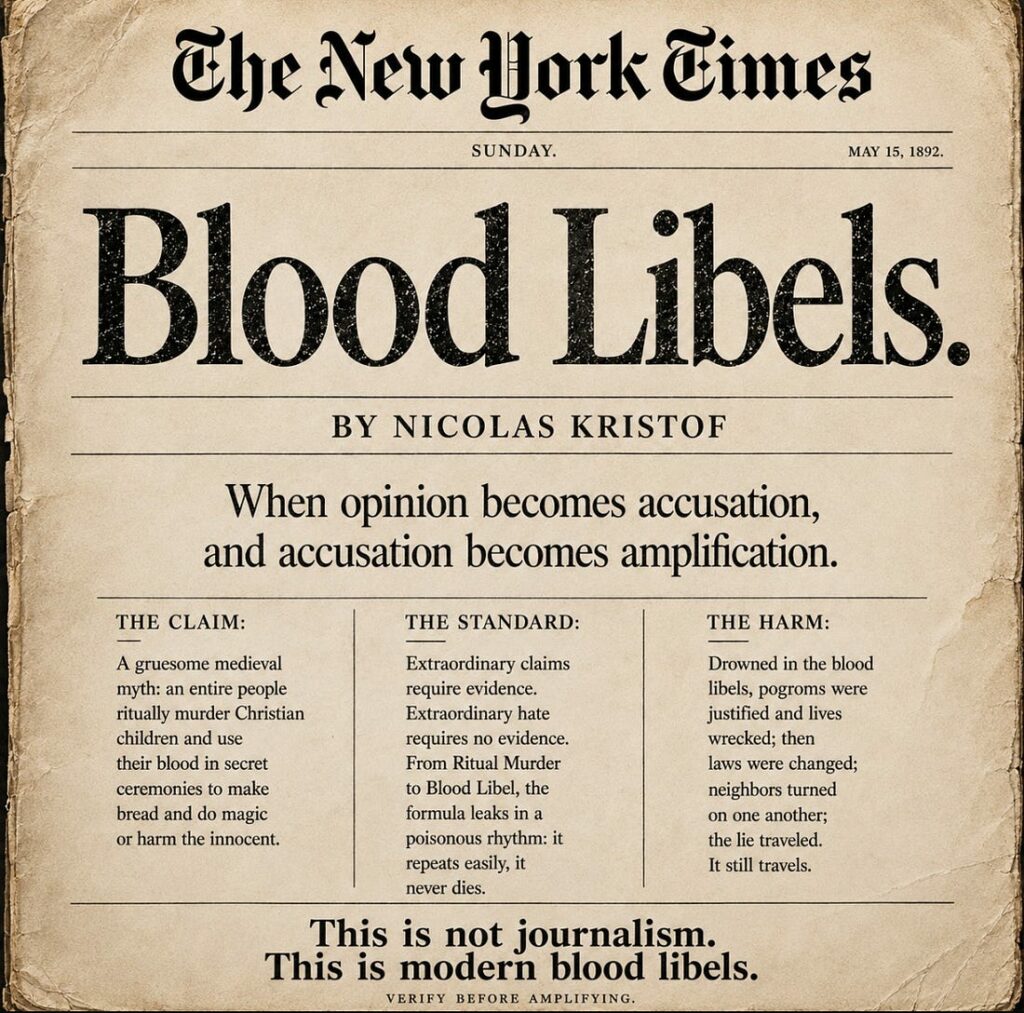
There are accusations that do more than describe a fact: they reactivate a memory of persecution. Nicholas Kristof’s column in The New York Times, published on May 11, 2026, belongs to that category. Beneath the guise of humanitarian journalism, it revives an old antisemitic matrix: that of the blood libel, the ritual murder accusation that long cast Jews as embodiments of a cruelty imagined as absolute and irreducible.
The Israeli response announced on May 14 should not be read as a mere expression of irritation. It signals that a line has been crossed, not only in the content of a column, but in the manner by which certain media institutions transform allegations into moral climate. This is not merely a matter of law; it is a matter of symbolic structure. And that is precisely where the problem begins.
In the United States, litigation is notoriously difficult terrain for a public plaintiff. Since New York Times Co. v. Sullivan, case law has required proof not only of falsity and harm, but also of actual malice: knowledge of falsity or reckless disregard for the truth. It would therefore be naïve to assess this matter solely in terms of its immediate chances in court. Law does not merely serve to remedy; it also serves to interrupt normalization, to raise the cost of drift, to force a system to confront itself. Some actions matter less for the judgment they obtain than for the limit they draw, for the threshold they establish. In that sense, the action brought against The New York Times must be understood as an act of intellectual deterrence as much as a legal proceeding.
For what is at stake here does not concern ordinary criticism of Israel. No democratic state is exempt from scrutiny, and Israel no more than any other. But between investigating abuses and, under cover of investigation, reviving the image of the Jew as a being of inherent perversity, there is a threshold. To cross it is to leave the register of information and enter that of symbolic reactivation. The blood libel never depended on plausibility. Its force lay in its excess. It did not seek to persuade through logic but to soil the image. It did not say: individuals committed crimes. It insinuated: this community bears within itself a peculiar cruelty, and that cruelty is almost anthropological.
This is the mechanism one must recognize when, in a column, there follow, without sufficient caution, allegations of systematic sexual violence against soldiers, guards, “settlers,” and Israeli interrogators, up to the evocation of animals trained to rape detainees. Such a scene no longer belongs to simple reporting; it constructs an imaginary of abjection. And when a newspaper of that power prints such an imaginary, it does not merely produce paper: it manufactures reality.
The problem is therefore not only the fragility of the sources, but the validation method that underpins them. Incomplete testimony, activist trajectories insufficiently disclosed, narratives that harden from one version to the next, recourse to politically situated or even terrorist-linked intermediaries without adequate critical scrutiny—all this does not amount to a mere lack of rigor, but to the very architecture of the text. In an affair of this gravity, editorial complacency becomes a politically qualified failing.
Prestige does not alter that. Quite the opposite: the more prestigious the institution, the heavier its error. The New York Times does not publish a column like a second-tier website; it converts it into a point of reference, an authority, and raw material for other newsrooms, other languages, other controversies. An accusation published at that level does not circulate as an opinion. It enters public space in the form of atmospheric certainty, more solid than many verified facts.
This is where the politicization of timing comes in. Kristof’s column appears at the very moment when the Israeli Civil Commission, tasked with documenting the crimes of October 7, 2023, publishes Silenced No More, a report based on more than 400 testimonies and nearly 2,000 hours of visual analysis, concluding that sexual violence was central to the attacks of October 7 and to the abuse of hostages. The effect of superimposition is obvious: on one side, Jewish victims whose suffering still struggles to impose itself in public space; on the other, a narrative that restores Israel to the role of the moral accused par excellence. Such inversion is never neutral. It does not merely contest an investigation; it displaces its center of gravity. It does not simply make reality more complex; it overlays it. And in that overlay, the language of human rights sometimes becomes the perfect screen for an old accusatory economy.
That is where the issue goes beyond the Kristof case. In the United States, The New York Times enjoys exceptional legal protection. Other media outlets, by contrast, will have neither the same constitutional shielding, nor the same depth of legal counsel, nor the same ability to transform a challenge into a matter of principle. The message to European, French-language, or international newsrooms is clear: reproducing an accusation of this kind will not be without consequences, because a major American title does not absolve anyone by mere capillarity. American law protects the press; it does not protect others’ recklessness. And in different legal systems, the dissemination, translation, simplification, or amplification of a libel can prove costly. That is precisely why this action, even if its outcome remains uncertain, has a reach that far exceeds the courtroom in which it may fail.
It establishes a limit. It says that certain narratives can no longer be recycled with impunity beneath the mask of moral journalism. It says that humanitarianism does not dispense with verification. It says that compassion does not justify carelessness. Above all, it says that an accusation directed at Jews is never just another accusation, because it awakens a long, murderous archive that remains perpetually available.
At bottom, what is at stake here is the very notion of media responsibility. A media outlet is not merely a relay. It is a power of classification, hierarchy, and legitimation. It decides which forms of suffering become visible, which sources appear credible, which images acquire the status of evidence. When it errs at that level, it does not commit a mere editorial mistake: it manufactures a context, drawing an imaginary line between legitimate victims and legitimate accusations.
And it is against that context that the Israeli response acquires meaning. Not as a complaint of irritation, but as an attempt to redefine the threshold of the sayable. Not as a rigidity, but as a response to a structure. Not as a private grievance, but as a signal addressed to all those who imagine they can recycle the oldest antisemitism in the newest words.
The blood libel has not disappeared. It has merely changed period costume, dictionary, and address. Yesterday, it passed through the pulpit or the village rumor; today, it can borrow the grave voice of a major newspaper and the lexicon of human rights. That is precisely why it must be named. And that is precisely why it must be resisted before it becomes banal once more.
The New York Times enjoys a constitutional shield that others elsewhere will not have. Those who, tomorrow, take up this libel in other languages, under other jurisdictions, and before other courts, will not be able to say they had not been warned.
© Fundji Benedict (16.05.26)

Dr. Fundji Benedict, Fondatrice et Présidente de Liberty Values & Strategy Foundation, est spécialisée en sciences politiques, anthropologie, droit international et études africaines. Sa triple identité – afrikaner, franco-éthiopienne et juive – nourrit une perspective unique sur les dynamiques géopolitiques et les questions identitaires contemporaines.
Polyglotte, elle a occupé des postes de direction dans des entreprises internationales aux États-Unis et au Canada avant de créer sa fondation. Ses recherches portent sur les conflits identitaires, les droits des minorités, la décolonisation et l’État de droit, avec un focus particulier sur le Moyen-Orient et la Corne de l’Afrique.
Elle intervient régulièrement sur l’antisémitisme, le terrorisme et les réalités géopolitiques complexes qui façonnent notre époque. Son approche combine rigueur académique et engagement de terrain auprès des communautés concernées.