Now living in Montreal, Edna Anzarut-Turner recalls how her family was forced to leave Egypt in the 1950s. She was deeply disappointed by her return visit many years later and has no regrets about fleeing a country she no longer recognised.

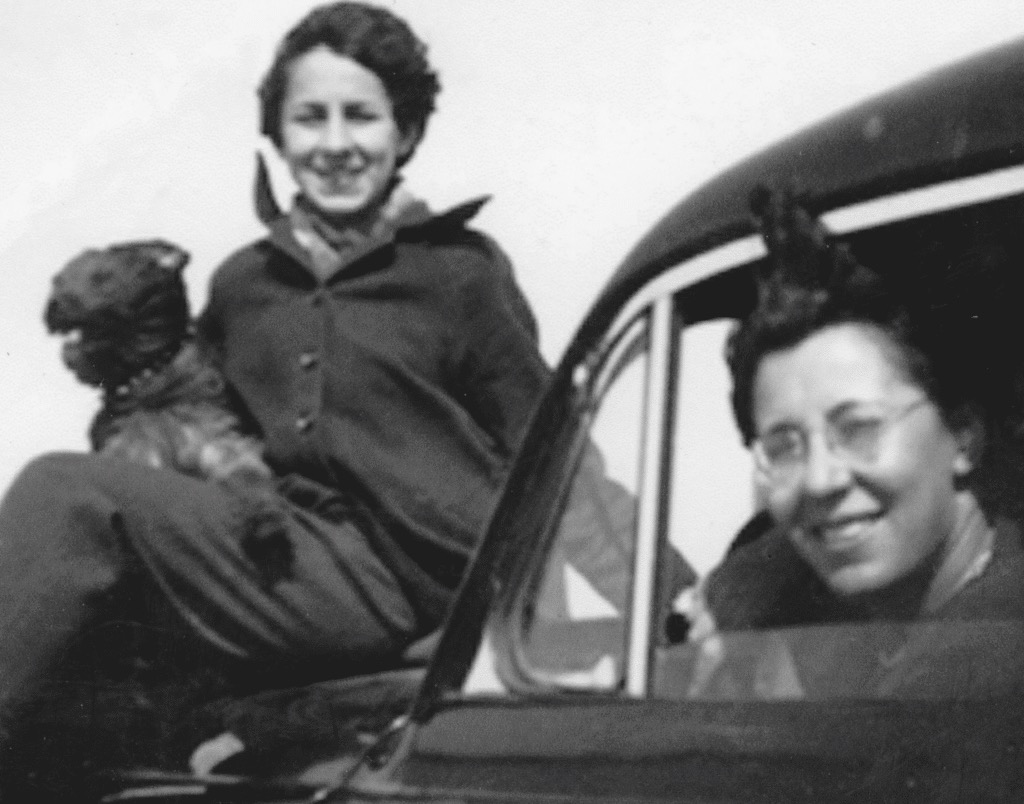
I was born in Alexandria and so was my mum, the daughter of a Palestinian Jewish mother from Safed, and a father from Tbililsi (Georgia). My dad was born in my grandparents lavish three-storey stone country house in Aley (in the Shouf mountains near Beirut). We Anzaruts are British by birth and by descent, and my dad fought in El Alamein under Monty. My dad was a banker, a lauréat alumnus of the École des Hautes Finances of the Université de Nancy: he graduated first with an average of 99.99%. My mum, who was also a brilliant woman, was editor of Agence France Presse in Alexandria and the first woman to become a member of the all-male Press Club there. Among others, she interviewed King Farouk and Mrs. Rommel when the latter visited El Alamein. We were members of the Alexandria Sporting Club and the Club Royal de Chasse et de Pêche in Silsilleh.


The family’s Alexandria mansion built by Edna’s great-grandfather Ezra Anzarut. The entrance pillars were made from marble from Carrara and had the initials EA carved on each one.
It was a beautiful, idyllic life in a spotlessly clean, very European city.
Fast forward to deposed King Farouk’s expulsion from Egypt. He was driven from his palace of Raseltine in the US ambassador’s limousine. This occurred early in the morning, and we watched at close quarters, thanks to my mum’s sahaffa – press fanion on her car. A motor boat took him to his British-built yacht, the Mahroussa. Another motor boat soon followed, carrying the police, who demanded King Farouk return all the gold bullion and priceless treasures that he had taken on board the Mahroussa. The deposed king aimed his gun at them and threatened to shoot anyone who tried to board the yacht. The police were still intimidated by the King and left empty-handed.
In 1956, my parents were in Europe, and heard about the Suez crisis, and the British Embassy in Cairo nonstop frequent warnings that British citizens must leave Egypt immediately. They took the first plane back to Cairo where we had recently moved. We lived on Rue Adly, near the synagogue, in a superb penthouse boutique high-rise, with two wraparound roof gardens overlooking the magnificent Mukkatam hills. Within a week, my mum ensured I had warm made-to-measure clothes, an exit and return visa on my British passport and a suitcase packed with expensive gifts bought at El Khan Khallil for my dad’s cousin and family who lived in Whitley Bay, Northumberland (UK). They had responded to my dad’s telegram: «Edna is welcome».
I returned to Alexandria to say goodbye to my beloved Nonno and Nonna, and they insisted I walk around Alexandria one last time. I went to the Sporting Club. It was desolate. I sat at the golf house restaurant and the waiters all rushed to offer pastries and ahwa sukkar zyada (sweetened coffee). They were all terrified. « Mazmazelle Edna, what are we going to do… how are we going to earn a living? »
I walked down the beautiful corniche to Silsilleh, and contemplated the rest of the superb city where I was born. The streets were empty. Alexandria was in mourning. I was able to take my precious Luthier-made classical guitar out of Egypt with me.
After my departure, my mum went to see the Swiss Ambassador and ask him to take some money for me in his diplomatic pouch. His response was: « Mme Anzarut, que faîtes-vous encore ici? C’est plein de Nazis! Voulez-vous être transformée en abat-jour? Partez, partez! »* My parents immediately prepared one suitcase and one blanket. As they had not been expelled yet, an exit and a RETURN visa were stamped on their British passports. My mother filled all the vases in our penthouse with beautiful flowers, drove our cars, one after the other, into separate public garages – and threw the keys in the Nile.
As my parents waited for the taxi to take them to the airport, there was a loud banging at the door. The police had arrived with an expulsion order. The situation was so incongruous that my parents burst out laughing. The policemen were shocked! « You’re too late, » my parents exclaimed, and showed them their suitcase, airline tickets and passports! Then my dad roared at them « BARRA. BARRA. EMSHEE MIN HENNA! » (‘Out, out! get out of here!’) My parents gave one last look at our beautiful flowered home, and went down one of the five elevators to their waiting taxi.
Despite arriving in London totally dispossessed, thanks to my dad’s banking reputation he was head-hunted by Recanati, and within a year my parents owned their own home in Orpington (Kent). They chose Orpington because much older Alexandrian friends, the Cohens, wanted them to live near by, and it was a lovely area. My dad’s job was to buy British merchant banks and reorganise them into one big bank. Tragically, due to the terrible stress my parents experienced in Egypt during Nasser, my beloved best friend, my dad, developed horrific, painful, incurable cancer of the oesophagus, and died in England at the age of 52.
My future husband Laurence was in California for a year. He returned to England to marry me… we will have been married 63 years next June 2025. Many years later, we were in Israel to celebrate our youngest son’s Barmitzvah.
Egypt had just started direct flights from Israel to Cairo. Laurence decided to buy tickets to fly to Egypt as he and our three sons wanted to visit the country of my youth. I refused to return to Alexandria, which according to a friend of my mum’s had become a huge ziballah (rubbish tip) on top of other ziballahs. I recognised absolutely NOTHING in Cairo, where we were constantly followed by the not-so-secret, secret police. The taxi drove past what used to be our boutique penthouse high-rise. I didn’t recognise it. The lavish entrance was no more. Extra flats had taken over the space. Balconies were crumbling everywhere. The overpopulated city was so polluted that it burnt right through the fabric of my dress. We went to our old exclusive club, The Guezireh Sporting club. It was filthy, and parts of it had been taken over by the city. We flew to Upper Egypt. There again we were followed nonstop. Having visited Upper Egypt at least a dozen times with my parents, I was horrified to see what an unhealthy, dusty, filthy mess it was.
Upon our return to Cairo, we discovered that our three sons’ backpacks had been torn to shreds. I went absolutely berserk.These people had DARED to destroy our sons’ possessions. I demanded to be refunded. The airport security took our eldest sons’ Canadian passports and ordered them to follow. Our sons are 6’2, extremely athletic-looking soccer players, sailors and skiers, and the security thugs probably thought they were members of Tsahal (the Israeli army). God only knows what these security goons had in mind. I hopped over the barriers, kicked the secret police, grabbed the passports and yelled at my sons to rejoin their dad immediately. I was finally taken to the rayess (the boss), an evil-looking man, and demanded a refund of US $.150.00 per rucksack. He finally PAID the greatly-inflated price. We returned to Israel via coach and crossed the Suez Canal. Unlike some people who, after revisiting Egypt, left with a nostalgic lump in their throat, I left that country and thanked God a million times for the Second Exodus. *Mrs Anazut, what are you still doing here? It’s full of Nazis. Do you want to end up as a lampshade? Leave, leave!”
© Edna Turner
Source: Jewish Refugee Blog
https://www.jewishrefugees.org.uk/2025/05/eda-turners-return-to-egypt-i-recognised-nothing.html
About the Jewish Refugee Blog
In just 50 years, almost a million Jews, whose communities stretch back up to 3,000 years, have been ‘ethnically cleansed’ from 10 Arab countries. These refugees outnumber the Palestinian refugees two to one, but their narrative has all but been ignored. Unlike Palestinian refugees, they fled not war, but systematic persecution. Seen in this light, Israel, where some 50 percent of the Jewish population descend from these refugees and are now full citizens, is the legitimate expression of the self-determination of an oppressed indigenous, Middle Eastern people.
This website is dedicated to preserving the memory of the near-extinct Jewish communities, which can never return to what and where they once were – even if they wanted to. It will attempt to pass on the stories of the Jewish refugees and their current struggle for recognition and restitution. Awareness of the injustice done to these Jews can only advance the cause of peace and reconciliation.
(Iran: once an ally of Israel, the Islamic Republic of Iran is now an implacable enemy and numbers of Iranian Jews have fallen drastically from 80,000 to less than 10,000 since the 1979 Islamic revolution. Their plight – and that of all other communities threatened by Islamism – does therefore fall within the scope of this blog.)